Comparison
AI resume builder vs resume tailoring tool
A resume builder helps create a document. A resume tailoring tool helps adapt a reliable resume to a specific role without losing accuracy or context.
By Yuvraj Bajwa, Founder, Resumae
Short answer: most job seekers need both, in that order. A builder gives you a clean base document once. Tailoring adapts that base for each job you apply to. The first gets your resume read; the second gets it ranked.
| Question | AI resume builder | Resume tailoring tool |
|---|---|---|
| Starting point | A prompt, an intake form, or a blank template | Your master resume and a specific job description |
| Problem it solves | Structure: a clean, parsable document | Relevance: does this resume match this role? |
| Main job | Create resume copy and layout | Adapt existing experience to one posting |
| Risk | Generic or inaccurate output | Overfitting if you accept every suggestion blindly |
| Best for | A first draft when you have no usable resume | Every application after that |
What an AI resume builder does
A resume builder generates a document from a prompt or a short intake form. That helps when the page is blank: you get templates that follow hiring conventions, standard sections for work history, education, and skills, and output an applicant tracking system can parse. Formatting matters more than it looks. A complex table, an unusual font, or a creative layout can stop an ATS from reading your details at all.
The trade-off is context. A generator has not seen your project history, so it fills gaps with plausible-sounding lines that can drift from what you actually did, and recruiters notice inflated titles and vague achievements quickly. And by design it produces one universal document. A builder makes your resume clean, not relevant.
What resume tailoring does
A tailoring workflow starts from material you trust: your existing resume plus the job description you want. It maps your experience against the posting, surfaces requirements and keywords you do not yet cover, and proposes edits grounded in wording you supplied:
- Using the terms the posting actually asks for
- Moving the most relevant experience to the top
- Reframing the summary around the employer's priorities
- Leading with the achievements that map to the role
Because every change traces back to something real on your resume, review stays fast and the finished document survives follow-up questions in an interview.
Why job match beats formatting
A resume that parses cleanly has only cleared the first hurdle. Two resumes can be read perfectly by the same system, every field captured, and still rank far apart, because the ranking depends on how closely each one matches the posting. Modern systems look for concrete skills, tools, actions, and credentials from the job description, not the word "leadership" repeated fifteen times. A clean resume gets read; a tailored one gets ranked.
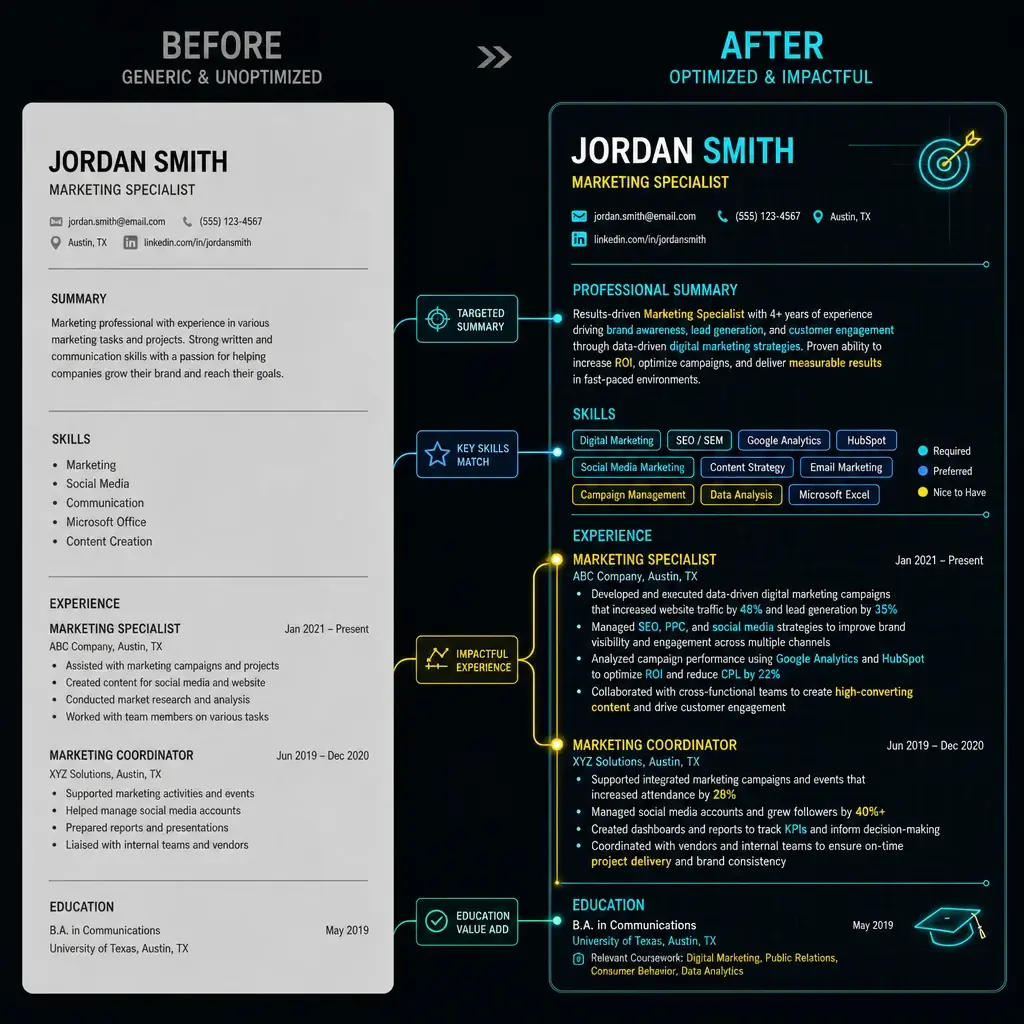
Here is the difference on the same facts, for a marketing coordinator applying to a growth marketing role:
- Master resume: "Managed social media accounts and created content for the company blog."
- Tailored: "Owned Instagram and LinkedIn strategy, growing engaged followers 28% in six months; partnered with product to launch three campaigns that drove 1,200+ qualified signups."
Nothing was invented. The tailored line leads with the outcomes the employer asked for, in the posting's language.
The workflow: build once, tailor every time
- Build a solid master resume. Use a builder, a clean template, or a plain document to get a well-structured, parsable base that holds all of your experience.
- Tailor it for each application. Compare it with the posting, cover the must-haves you genuinely have in the employer's terms, and reorder bullets so the most relevant come first.
- Review before you send. Make sure the changes read naturally and have not broken the clean structure from step one.
The step-by-step version is in how to tailor your resume.
When to use each
A builder alone is enough when:
- You have no resume yet and need a base document quickly.
- You apply to the same role with the same requirements every time.
You need tailoring as well when:
- You apply to varied positions, even within one industry.
- You have sent 20 or more applications with no callbacks.
- You are competing in a field with many qualified applicants.
The question to ask any tool
Before choosing either approach, ask where the words come from. If the answer is a model guessing at your background, budget time to fact-check every line. If it is your own experience reorganized for one posting, most of the work is already done. Both approaches have a place; they simply solve different problems. For more on choosing, see Resumae alternatives.
How Resumae fits
Resumae is built around tailoring. It reads the posting, compares it with your resume, shows fit and ATS coverage, then helps you review the changes before export. That makes it better suited to targeted applications than one-off resume generation.
Read the AI resume tailoring guide or see the Resumae workflow.

About the author
Yuvraj Bajwa
Founder, Resumae
Yuvraj Bajwa is the founder of Resumae, an AI job-search workspace built as part of Coffee Drop Studio. He writes and reviews the resume, cover letter, interview, and application-tracking guidance on this site, drawing on the day-to-day work of building the tailoring, fit analysis, and ATS tools the articles describe.
- Founder
- Product lead