Interview Prep From a Job Description: Predict the Questions
Turn any job description into interview prep: predict the questions, map STAR stories to each requirement, and ask sharper questions of your own.
By Yuvraj Bajwa, Founder, Resumae
July 6, 2026 · Updated October 16, 2026 · 7 min read
Resumae articles are written to help job seekers make better application decisions and are reviewed against our editorial policy.

You got the interview. Most candidates now skim their own resume, read the company’s About page, and hope for the best.
The better source is the job posting you stopped reading when you hit “Apply”. It tells you what the employer values, which questions they are likely to ask, and the language they will listen for. You just have to read it as prep material instead of as an application checklist.
Why the posting is your best prep tool
A posting lists the qualifications, qualities, and background the employer wants (Indeed). Interviewers usually build their questions from that same list, because it is the document they used to define the role. Analyzing it closely shows you which themes the interview will cover (University of Minnesota career services).
Step 1: Read the posting three times
Each pass looks for something different.
Pass 1: must-haves and nice-to-haves. Mark the language that signals a requirement (“required”, “must have”, “essential”) and the language that signals a tiebreaker (“preferred”, “a plus”, “bonus”). Prepare for the must-haves first. The nice-to-haves are where you can stand out once the essentials are covered.
Pass 2: repeated terms. If “project management” appears five times, it is the core of the role. If “collaboration” keeps coming up, expect teamwork questions. List these terms; they are your cheat sheet.
Pass 3: responsibilities. Circle every action verb and named tool. “Lead cross-functional projects” is a story you need. “Experience with Salesforce” is a term you should be ready to discuss. Anything you cannot map to your own experience is a gap, and gaps become your questions for them in Step 5.
Step 2: Turn each requirement into a question
Every requirement in the posting is a likely question. “Experience managing budgets” becomes “Tell me about a time you managed a budget”. “Strong written communication” becomes a question about something important you wrote.
| Posting says | Likely question |
|---|---|
| “5+ years of experience in sales” | “Tell me about your sales experience. What was your biggest win?” |
| “Strong analytical skills” | “Walk me through a time you used data to make a decision.” |
| “Ability to work in a fast-paced environment” | “How do you handle multiple priorities under tight deadlines?” |
| “Experience with Salesforce” | “How do you use Salesforce in your current role?” |
| “Optimize landing page conversion” | “How would you troubleshoot a drop in conversion rate?” |
Write them all down. You now have a question bank built for this role, not a generic list of 100 interview questions.
Step 3: Map a STAR story to each top requirement
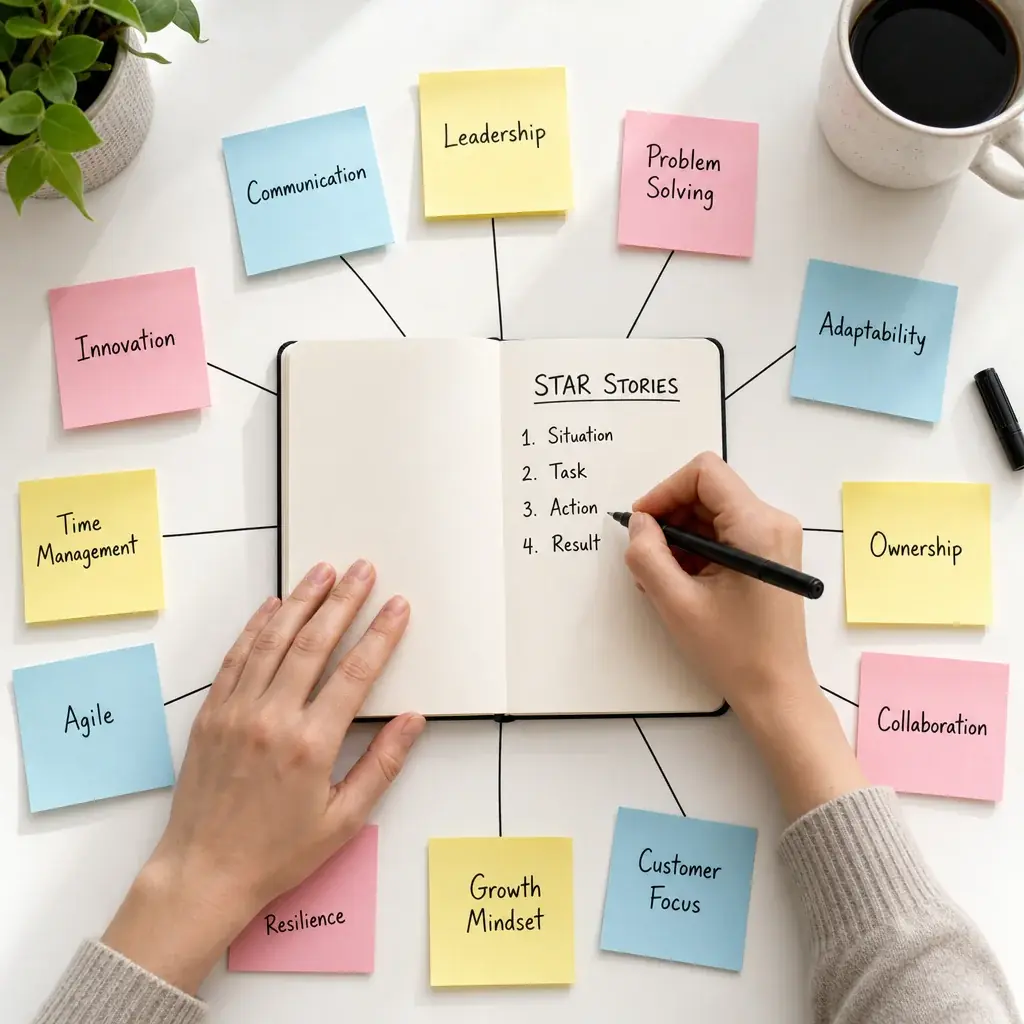
For the five most important requirements, prepare one specific story each. The STAR structure keeps it tight:
- Situation (two sentences at most): the context.
- Task (one sentence): what you were accountable for.
- Action (two or three sentences): what you did. Not the team. You.
- Result (one sentence): the outcome, with a number if you have one.
Say the posting asks for “experience leading cross-functional teams”:
- Situation: A product launch had engineering, marketing, and sales working from different plans.
- Task: I was asked to coordinate the launch across all three.
- Action: I set up weekly syncs, a shared tracker, and one owner per workstream.
- Result: We launched on time, hit the first-month sales target, and the process became the template for later launches.
Compare the vague and the specific answer:
- Before: “I’ve led projects before and I’m good with people.”
- After: “The posting emphasizes leading cross-functional teams. In my last role I coordinated a launch across engineering, marketing, and sales, and we shipped on time and beat our adoption target.”
Keep each story under 90 seconds out loud, and put a number in every result. “Reduced turnaround time by about 30%” lands; “improved the process” does not. If you do not know the exact figure, estimate conservatively.
Step 4: Use the employer’s language in your answers
Keywords are not only for getting past the ATS. When your answers use the posting’s terms, the interviewer hears a fit before you have finished proving it.
Build a short bank of 10 to 15 terms from the posting and use them where they are true. If the posting says “managed vendor relationships”, say “I managed vendor relationships”, not “I worked with outside companies”. It feels forced at first; practice until it sounds like you.
Step 5: Research the context, then ask about the gaps
The posting tells you what the role does. Research tells you why it exists: recent company news, products, competitors, leadership, and what employees say about the culture. For a marketing role, know the company’s biggest marketing challenge. For a technical role, know the stack.
Then use the gaps in the posting to prepare three to five questions of your own:
- “The posting mentions [responsibility]. How does the team approach that today?”
- “What does success look like in the first 90 days?”
- “The posting lists [skill]. What level does the team need most?”
- “When the posting says fast-paced, does that mean daily reprioritization or weekly sprints?”
Questions like these show you read carefully, help you judge the job, and make you memorable.

Step 6: Practice out loud
Rereading notes silently does not prepare you to say them. A 30-minute block works well:
- 10 minutes: say the posting’s key terms and your one-line fit statement out loud.
- 15 minutes: run each STAR story and time it.
- 5 minutes: answer the “gap” questions on the spot.
Record yourself on your phone. Listening back is uncomfortable, and it is the fastest way to catch filler words and rambling. Spread prep across several days if you can: one day on the posting, two on stories, the rest on practice.
Common mistakes
- Skipping the nice-to-haves. Partial experience with a preferred skill can tip a close decision. Prepare a short story anyway.
- Reusing generic stories. A “teamwork” story for remote collaboration should differ from one for cross-department coordination.
- Memorizing scripts. Learn the structure and the numbers, not the words, so you can adapt to follow-ups.
- Treating the posting as a script. It points to themes, not exact questions. Expect curveballs.
- Forgetting the why. “Why this role?” should be easy by now: your stories match their needs, and their needs match your direction. Say that connection outright.
Checklist before every interview
- Read the posting three times: must-haves, repeated terms, responsibilities
- Wrote at least five likely questions from the requirements
- Have a STAR story with a number for each of the top five requirements
- Can explain how you match the must-haves in under 30 seconds
- Know the company’s core product and one recent piece of news
- Prepared three to five questions from the posting’s gaps
- Practiced every story out loud at least once
How Resumae helps
Resumae’s Prep Studio reads the posting and the resume you tailored for it, then generates likely questions, talking points, and mock interview prompts tied to that specific role. Everything stays with the application, so the claims you prepare are the ones you actually sent.
Start with the AI resume tailoring guide, or keep your roles organized with the job application tracker guide.
Frequently asked questions
How can I predict interview questions from a job posting?
Find the repeated terms and hard requirements, then turn each into a question, such as “Tell me about a time you managed a budget”. Prepare a STAR story that shows you have that experience. The mapping turns the posting into a practice script.
How many STAR stories should I prepare?
One for each of the top five requirements. That covers most of an interview without becoming unmanageable. Keep each under 90 seconds and include a measurable result.
How should I handle requirements I don’t fully meet?
Be honest, then redirect to related strengths. If you have not used a tool the posting names, mention similar tools you have used and how quickly you picked them up, or outline how you would learn it.
How early should I start preparing?
As soon as the interview is scheduled, ideally four to seven days out. Spreading prep across days improves recall and lowers interview-day stress.
Key takeaways
- The posting is the roadmap. It shows what the employer values and what they will ask.
- Turn every requirement into a question and answer it with a specific, quantified STAR story.
- Use the employer’s language in your answers, and use the posting’s gaps for your own questions.
- Practice out loud, not on paper.

About the author
Yuvraj Bajwa
Founder, Resumae
Yuvraj Bajwa is the founder of Resumae, an AI job-search workspace built as part of Coffee Drop Studio. He writes and reviews the resume, cover letter, interview, and application-tracking guidance on this site, drawing on the day-to-day work of building the tailoring, fit analysis, and ATS tools the articles describe.
- Founder
- Product lead
Related reading
How Long Should a Resume Be? 1 vs 2 Pages (2026)
Stop guessing resume length in 2026. See data from HR surveys and industry standards, plus the federal two-page rule, to choose 1 or 2 pages confidently.
How AI Resume Screening Works in 2026: Complete Guide
See how AI screening tools parse and score resumes in 2026, plus step-by-step strategies to avoid auto-rejection and land more interviews this year.
Job Application Tracker Guide: Features That Matter
What to track for every job application, the tracker features that cut missed follow-ups, and how to keep each role's resume and notes in one place.
Next step
Ready to build a resume that gets noticed?
Paste a job description and let AI tailor your resume - free plan, no credit card required.