Google XYZ Formula: Write Resume Bullets That Get Read
Stop listing duties in 2026. Learn Google's Accomplished [X] as measured by [Y] by doing [Z] formula with before-and-after examples for every role.
By Yuvraj Bajwa, Founder, Resumae
July 12, 2026 · Updated August 7, 2026 · 8 min read
Resumae articles are written to help job seekers make better application decisions and are reviewed against our editorial policy.
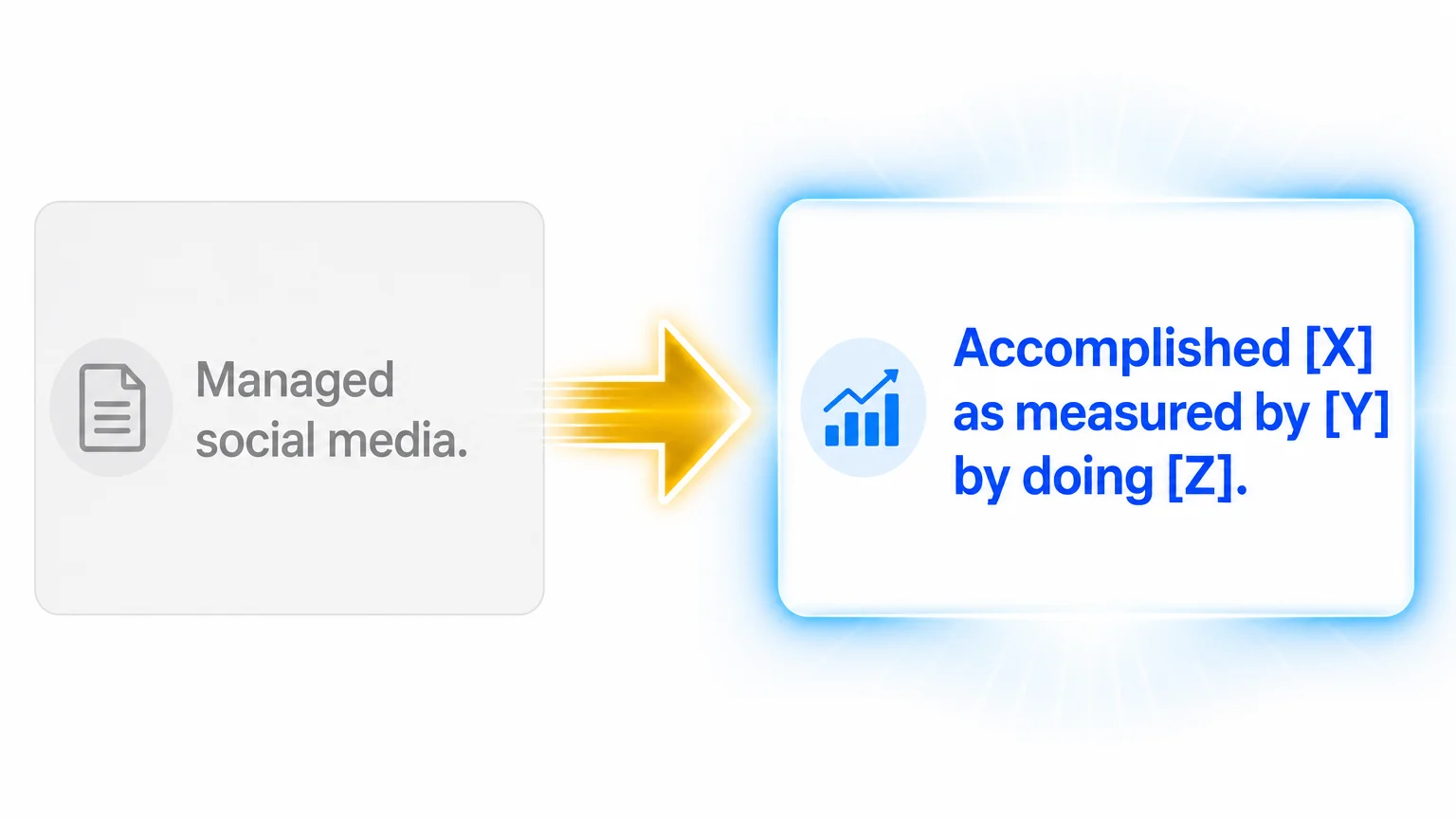
Your resume has bullet points, but do they show what you achieved?
Most people list what they were supposed to do. Hiring managers want to know what you actually achieved.
The XYZ formula offers a simple way to change that. Laszlo Bock, former SVP of People Operations at Google, popularized it after sharing it in his book Work Rules! and on LinkedIn (source).
This post shows how to reframe resume bullets with the formula.
Where the XYZ Formula Came From
Laszlo Bock spent years figuring out what makes a resume stand out at one of the most selective companies on earth. The formula he landed on is deceptively simple (source):
“Accomplished [X] as measured by [Y] by doing [Z].”
The three variables turn a list of duties into a description of impact.
- X = What you accomplished (the result)
- Y = The metric that proves it (the measurement)
- Z = The action you took (the method)
The formula does not mean Google requires a specific format. It helps because it makes you describe value instead of only activity.
Breaking Down the Formula
Here is a concrete example for each piece.
Duty-based bullet point: ‘Managed the company blog.’
XYZ version: ‘Increased organic blog traffic by 40% in Q3 by implementing a keyword-optimized editorial calendar and republishing top-performing posts.’
Here’s how it maps:
| Variable | Definition | Example |
|---|---|---|
| X (Accomplishment) | The specific result | ‘Increased organic blog traffic’ |
| Y (Metric) | The measurable outcome | ‘by 40% in Q3’ |
| Z (Method) | How you did it | ‘by implementing a keyword-optimized editorial calendar and republishing top-performing posts’ |
Use this structure for bullets when the details support it. It shifts the focus from showing up to work to showing what you made happen.
Before-and-After Examples Across Real Roles
The examples below show how the formula works across different jobs (source, source).
Software Engineer
Before: ‘Fixed bugs in the payment system.’
After: ‘Reduced payment processing failures by 22% by refactoring the legacy transaction module and adding automated error-handling checks.’
Why it works: The ‘after’ version shows that you improved a system metric rather than only fixing bugs.
Marketing Manager
Before: ‘Managed email marketing campaigns.’
After: ‘Increased email click-through rate by 18% in 6 months by segmenting the subscriber list based on purchase history and personalizing subject lines.’
Why it works: The ‘after’ version shows that you understand the goal of marketing: increasing engagement, not just sending emails.
Project Manager
Before: ‘Led project teams.’
After: ‘Delivered a $2M product launch 3 weeks ahead of schedule by implementing a cross-functional sprint cadence and removing two approval bottlenecks.’
Why it works: The budget and time saved make the scope of your leadership concrete.
Sales Representative
Before: ‘Sold software to enterprise clients.’
After: ‘Closed 15 enterprise accounts worth $1.8M in new revenue in 2024 by developing a consultative discovery process and targeted ROI presentations.’
Why it works: The ‘before’ is generic. The ‘after’ gives evidence that you generated revenue.
UX Designer
Before: ‘Designed user interfaces for mobile app.’
After: ‘Improved first-time user task completion rate by 34% by redesigning the onboarding flow and conducting 5 rounds of usability testing.’
Why it works: Designers often focus on outputs such as prototypes and wireframes. The XYZ formula shifts attention to outcomes such as user behavior and task success.
Customer Success Manager
Before: ‘Handled customer escalations.’
After: ‘Reduced churn rate by 15% in one quarter by creating a proactive check-in protocol for high-risk accounts and triaging unresolved support tickets within 4 hours.’
Why it works: Instead of listing a reactive task, the bullet shows a retention effort tied to revenue.
How XYZ Differs from STAR
The STAR method (Situation, Task, Action, Result) works well for interviews, but it is too long for a resume (source).
On a resume, you get 1–2 lines per bullet point. That’s it. The XYZ formula fits perfectly into that space.
In an interview, you get 2–3 minutes to tell a story. That’s where STAR shines.
Here’s how they compare:
| Aspect | XYZ (Resume) | STAR (Interview) |
|---|---|---|
| Format | 1 sentence | 4-part story |
| Length | 15–25 words | 2–3 minutes |
| Focus | Result + Metric + Method | Situation + Task + Action + Result |
| Best for | Bullet points | Behavioral questions |
Use XYZ for the resume and STAR for the interview.
4 Common Mistakes That Ruin the Formula
Even with a template, these are common problems.
Mistake 1: The Metric Is Vague
Wrong: ‘Improved customer satisfaction significantly.’
Right: ‘Increased CSAT score from 82% to 91% in 4 months.’
Numbers don’t have to be perfect. An honest estimate is better than an empty adjective.
Mistake 2: The Z (Method) Is Missing
Wrong: ‘Increased sales by 25%.’
Right: ‘Increased sales by 25% by introducing a quarterly upsell campaign for existing accounts.’
Without the method, recruiters don’t know how you achieved the result. The Z proves you have a repeatable skill.
Mistake 3: You’re Still Listing a Duty
Wrong: ‘Responsible for onboarding new hires.’
Right: ‘Reduced new-hire ramp time by 30% by redesigning the 30-day onboarding checklist and assigning a peer mentor in week one.’
‘Responsible for’ is the biggest red flag. It means you’re about to describe a job description, not an achievement.
Mistake 4: You Try to XYZ Every Single Bullet Point
Sometimes a task doesn’t have a clean metric. That’s fine. Use the formula where you can, and write clear, active sentences where you can’t. The goal is a majority of impact-based bullets, not perfection.
Step-by-Step Worksheet: Reframe Your Own Experience
Use your current resume and reframe one bullet point at a time.
Step 1: Write the Duty Version
Write down exactly what your current bullet point says.
Example: ‘Managed the company social media accounts.’
Step 2: Ask Yourself: What Was the Result? (X)
Don’t overthink this. What happened because you did that thing?
Answer: ‘More followers. More engagement.’
Step 3: Find the Number (Y)
What metric can you attach to that result?
Answer: ‘Grew followers from 4,000 to 12,000. Engaged audience by posting 5x/week.’
Step 4: Identify How You Did It (Z)
What specific actions led to that result?
Answer: ‘Created a content calendar, ran one monthly giveaway, used viral trend templates.’
Step 5: Assemble the XYZ Sentence
Put it all together.
Before: ‘Managed the company social media accounts.’
After: ‘Grew Instagram followers from 4K to 12K in 6 months by publishing daily content, running monthly giveaways, and creating trend-based Reels.’
Now do this for your top 3–5 bullet points. You’ll see a pattern: the duty version always sounds weak compared to the quantified version.

Why This Formula Works on a Deeper Level
Recruiters spend about 6–8 seconds scanning a resume before deciding whether to read more. In that time, they look for signals rather than complete stories (source).
The XYZ formula catches the eye because:
- Numbers stand out. A percentage or dollar amount breaks the monotony of text.
- It proves cause and effect. You’re showing that your actions led to measurable change.
- It frames your role as strategic. You weren’t just doing tasks; you were solving problems.
- ATS systems love it. Applicant Tracking Systems parse quantifiable results more favorably than vague adjectives.
The formula also shows that you can communicate value, a skill that matters in every job, from entry-level to executive.
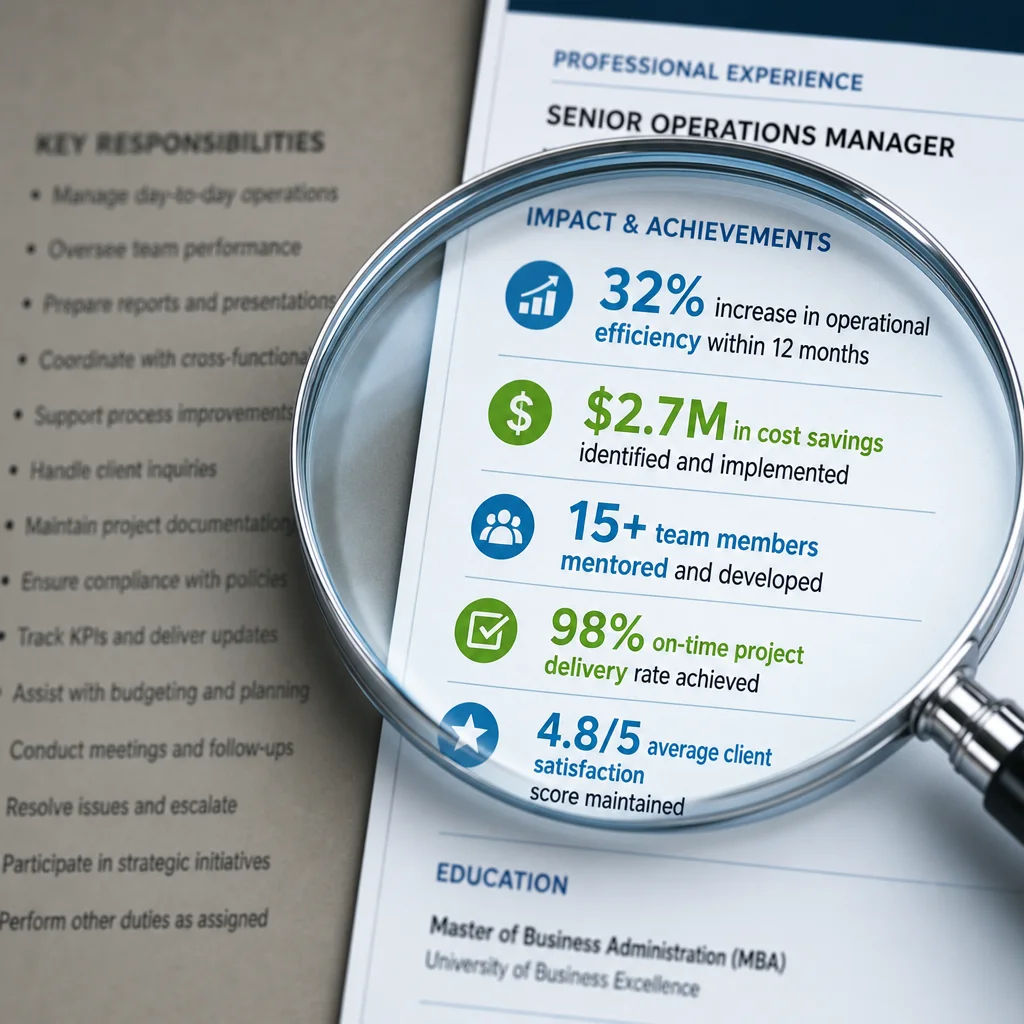
When the Formula Feels Impossible (and What to Do)
‘But I don’t have numbers!’
You may have more data than you think.
- Don’t know the exact percentage? Estimate. ‘Reduced customer complaints by approximately 20%’ is still powerful.
- Worked on a team project as one contributor? Use team metrics with your role attached. ‘Contributed to a 15% increase in user retention by redesigning the onboarding flow as part of a 3-person UX team.’
- In a role without clear metrics? Focus on time saved, volume handled, or process improvements. ‘Streamlined vendor approval process, cutting turnaround time from 5 days to 2 days.’
The goal is not perfect attribution. It is showing that you understand the language of impact.
The Quick Test for Every Bullet Point
Before you add a bullet point to your resume, run it through this checklist:
- Does it start with a strong action verb? (‘Managed’ is weak. ‘Launched’, ‘Built’, ‘Negotiated’ are strong.)
- Does it contain a number or percentage? (If no, can you add an estimate?)
- Does it explain how you achieved it? (Is the Z present?)
- Would a recruiter understand the impact in 3 seconds?
- If you removed the bullet, would the overall story weaken?
If you answered ‘no’ to any of these, rewrite it using XYZ.
Your Resume Is Now a Results Document
The main points are:
- The XYZ formula turns duty-based bullets into achievement stories
- Every role: from engineer to designer to sales, quantified results help
- Avoid vague metrics and missing methods; specificity is everything
- Use XYZ for resumes, save STAR for interviews
Writing a useful resume is not about listing everything you have done. Select the moments where you created measurable value.
The XYZ formula gives you a way to find those moments and present them clearly. Spend 30 minutes reframing your top bullet points.
Start with one bullet point. Pick the most impressive thing you’ve done in the last year and apply the formula.
Share it on LinkedIn or Twitter if it helps you rewrite your bullets.

About the author
Yuvraj Bajwa
Founder, Resumae
Yuvraj Bajwa is the founder of Resumae, an AI job-search workspace built as part of Coffee Drop Studio. He writes and reviews the resume, cover letter, interview, and application-tracking guidance on this site, drawing on the day-to-day work of building the tailoring, fit analysis, and ATS tools the articles describe.
- Founder
- Product lead
Related reading
Does Tailoring Your Resume Really Matter for ATS?
Learn the truth about ATS resume screening, why tailoring genuinely improves your chances, and how to customize efficiently without rewriting from scratch.
Sent 50 Resumes & Got Zero Callbacks: What Am I Doing Wrong?
Zero callbacks after 50 applications is fixable. See the real reasons your resume is being ignored and fix your next 50 applications.
Resume Fit Score Explained: What It Means and How to Use It
Demystify the resume fit and ATS score in 2026: how it is calculated, why it is not a job-fit verdict, and how to improve without chasing vanity metrics.
Next step
Ready to build a resume that gets noticed?
Paste a job description and let AI tailor your resume - free plan, no credit card required.